
Character Development and Arcs

Introduction
Every story is either considered character-driven or plot-driven, two concepts you may or may not have heard of, but you might agree on a simple fact: A good story always has rounded, well-developed characters. Likewise, flat characters without development can make your story feel empty, emotionless, but that works if the world around them changes.
Usually, plot-driven stories are the ones with flat characters, and that’s completely okay. Here’s a little secret: Every reader wants to escape reality through a good story, and plot-driven stories don’t require deep dives like character-driven ones. The clearest example, my dear Watson, is any Sherlock Holmes story; we already know Sherlock never changes, but the fun comes from solving a mystery.
Character-driven stories focus much more on developing characters, and they’re proactive participants. Their actions, their decisions, push the story forward, and these characters change through the story. For example, in Pride and Prejudice, the audience gets immersed in the story as they want to see Lizzie’s evolution: She judges someone upon first impression, but she comes to mistaken conclusions about Mr. Darcy. As the story progresses, Lizzie realizes she was wrong about Mr. Darcy only to learn that she shouldn’t judge someone so fast—and, plot twist, she loves Mr. Darcy. The main question is: How do we create and develop characters?
“Writing about emotions has to be artful, which is another way to say surprising.” — Donald Maass
Prerequisites
The most common advice is to write what you know. In this instance, scrap that out of your mind. Instead, change the advice to: Write how you feel. This is the only way your characters have relatable feelings and the best way for them to connect with a reader.
This is another tip: Outline your story. If you know what you’re going to write about, then it will be easier for you to focus on your characters, to plan their arcs and development. Their inner transformations will come more naturally than without planning. Besides, if you already know where your characters will be by the end, you can work backwards to give a better cohesion to the character transformation.
Common knowledge is that there are three types of character arcs: positive, negative, and flat. In the positive arc, as you may have guessed, the character learns something to become a better person. On the other hand, in the negative arc, the character changes for the worse. And in flat arcs, as contradictory as they sound, the character stays the same, but they change the world around them.
“Everything I learned about human nature I learned from me.” — Anton Chekhov
Warm-Up
Before you begin building your character arc, you must know that there are character archetypes and understand who your character truly is. For the latter, you can ask yourself six questions. The first one is, what do your characters do behind the scenes? Now, you might wonder why this is important, as we usually think of our characters and their roles in the story. Even when the reader won’t know it, it’s important for the writer to know the life of a character when they’re not in the story. After all, this develops their true nature. Quick tip: Imagine yourself as a detective, hired to follow your character all the time, and write down what you discover.
The second question is, how were they raised? Childhood and parenting has a massive impact on life. Your character’s parents taught them what was good in their eyes and what they should believe was bad. They shaped their perception of life. The next question is, what is your character’s ghost? Consider the ghost as the motivating force behind the character’s actions and desires, motivating them to make change or avoid it, and it can either be something in the future that the character fears or a traumatic moment from their earlier life.
Also ask yourself, what do the characters despise about themselves? This question shows the conflict and tension between who a character wants to be and who they actually are, and this is the beginning of a character arc that can grow or evolve along moral progression. The fifth question is, what are your character’s blind spots? To answer this, fill out the Johari Window like in the example below. The last question will be, what human needs do your character crave the most? There are six key human needs, split into three pairs, and these are certainty against variety, significance against love and connection, and growth against contribution. Ask your character which ones of these needs they value the most and which ones are a waste of time.
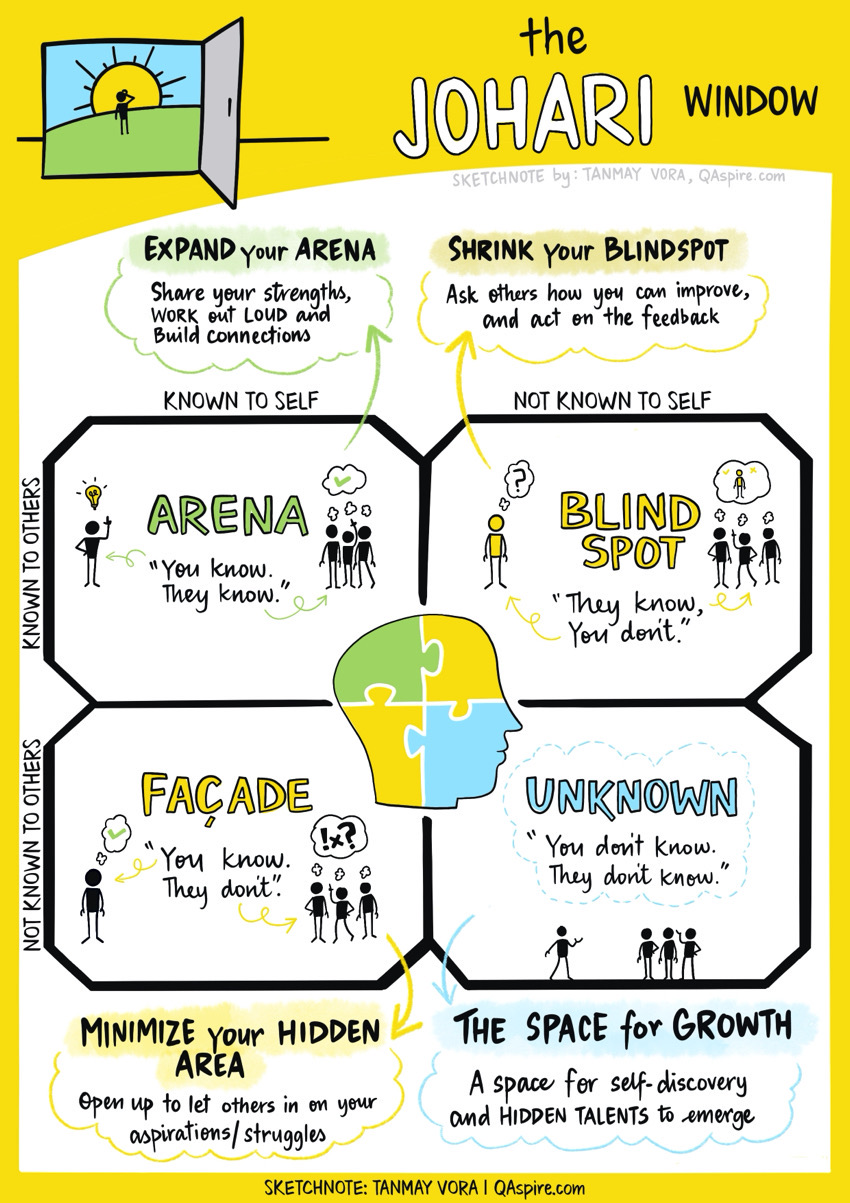
Now that you have asked yourself these questions, this is an extra tip for characters: Consider that they’re not static entities and that if a character doesn’t change, then the focus is on plot. But most importantly, characters are the reason why readers resonate with a story.
“The greater the pressure, the greater the depth of true character that is revealed.” — Robert McKee
Building the Characters
Once you know what makes your character relatable, you can focus on what’s important for your story: character development and arcs. Character development is the transformation of the inner world, meanwhile their arc is the progress of their story through the plot. There are many concepts for development and arcs like the four selves, static and dynamic, flat and round, and capability, reliability, proactivity, among others.
The Four Selves
This is a technique that adds depth, complexity, and realism to your story. Every character shows a different version of themselves in any situation, and these versions can be categorized in four selves:
Social Self: This is who the character is around strangers and how they’re perceived by the world around them. If you believe in astral charts, such as the zodiac signs (Leo, Aquarius, Pisces, among others), you can tie this self to the rising sign, to the first impression.
Personal Self: Quite the simplest to define, as it is who the character is around their close relations such as friends, lovers, and family.
Core Self: Who the character thinks they are when they’re alone? When they’re only with themselves and their thoughts. Tying back to astral charts, this is your lunar sign, how they feel when nobody sees them.
Hidden Self: Everyone has a dark, unknown side, even to themselves. This is the hidden self, defined as the subconscious depth and true nature of who the character really is.
Static and Dynamic
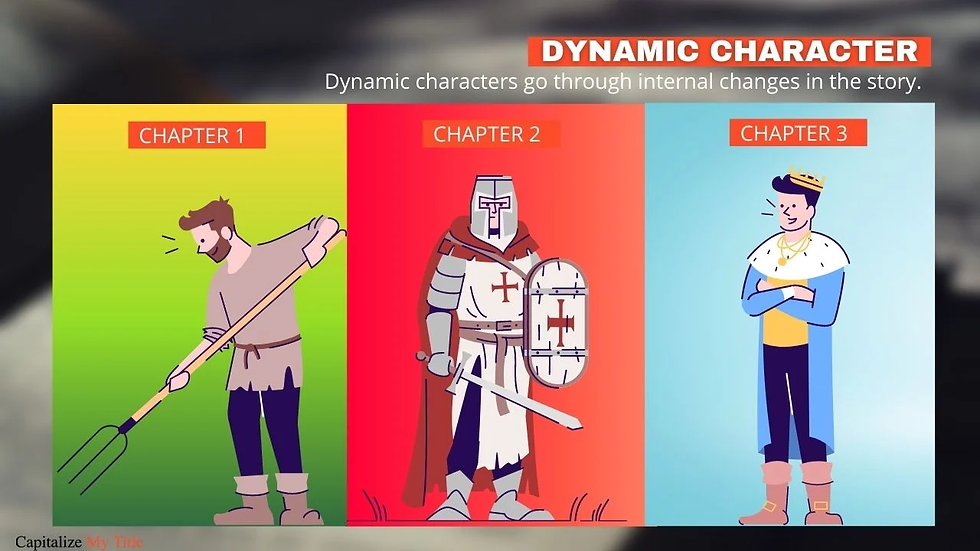
Static characters don’t change through the plot. They’re the same person at the end as they were at the beginning, and you can use them when the story is plot-driven or if the character experiences something they’ve experienced before—in other words, when they’ve been there, done that. They can also be static characters if they are minor characters without a need to grow, as they don’t have enough time to be dynamic.
Meanwhile, dynamic characters evolve throughout the story, and this is a result of their experiences. You can use them if the story is character-driven, when either the psychology or personal struggles matter on a big scale, or when they face new experiences, evolving for the better or the worse. With this definition in mind, consider that main characters need to be dynamic, as they’re more realistic and relatable. Besides, dynamic main characters are more engaging to read.
Round and Flat
Flat characters are one-dimensional, which means that they have few personality traits and don’t have much depth regarding their psychology. They are usually background characters, showing up for a small amount of time. This type of character usually appears in children's literature, as the story is simpler, or they also appear in plot-driven stories.
Round characters have multiple dimensions, multiple layers. Define layers as having multiple characteristics, which add depth that will make them more realistic and multidimensional. When creating round characters, if they have no personality outside the clichés, then you’re stereotyping them, which you should avoid. Keep in mind that round characters are working toward a goal, they’re facing the conflict to get this goal, and that they have development as the story goes on.
Core Components
Every writer will tell you a character has core components and list different ones. It’s up to you to decide which core components you’ll have in your character, but here is a list of a few that can make your character feel more real.
Ghost: This is a traumatic event that shapes the character’s worldview, usually happens before the story or at the start, and leaves an impact in the character’s psyche. If you’re working on a series, each book can have a new ghost.
Lie: Simply defined as an incorrect view of the world that hurts the character, the people around them, and leads them to pursue their want. The lie is the main reason for a character's flaws and makes them feel incomplete.
Want: Characters believe something external will bring them happiness or completeness, but it only brings them more suffering and power to the ghost haunting them. The pursuit of the want also strengthens the lie.
Need: This is the real element that will make the character feel complete and happy, but the only way to get it is to reject the lie and embrace the truth. The need also challenges the status quo of the world.
Truth: Vanquishes the lie and is a more accurate way, for the character, to view the world and themselves and their role within it. It is hard-won and, if you’re working on a book series, can open more difficult questions to face in the next book.
Emotional Stakes
In every story, anything can go wrong. In Avengers: Infinity War, spoiler alert, the plot twist is that Thanos wins, and half the universal population disappears, but this is a physical stake. Stories are more engaging when they have emotional stakes, when the characters stand to lose emotionally, and this causes certain emotional pain. For example, in The Last of Us, Joel loses his daughter, and the emotional stakes come from his parental relationship to Ellie.
There are three types of emotional stakes: reason, in which the external goal is tied to the emotional goal; risk, as the character has to risk either the internal stakes or the external ones to get one of the goals; and sacrifice, meaning that the external and internal goal contradict each other.
Now, you might wonder, how do you create emotional stakes? The answer is simple: There are three ways. You can reveal emotional stakes through relevant backstory as the character’s past wounds mirror the present. You can also create emotional stakes with side characters, showing how their fallout is bargained with both their choices and actions but also by the protagonist, putting the latter at a moral crossroads. Or you can give tragedy a narrative meaning, as long as it has a reason for the character.
CPR: Capability, Proactivity, Reliability
Brandon Sanderson advises that if you want to write compelling characters, think about how your passions could be a character, an arc, or a world-building element. In other words, “Write what you know,” but for building your characters. He also gives three main traits of compelling characters:
Capability: Competent people doing things competently, usually good at one thing or two, but also consider that they’re bad at other things and that their flaws balance out with their strengths.
Proactivity: This is the single thing that makes a character readable. The reader wants to see progress, and proactive characters move the plot forward. But don’t make the mistake of having a proactive villain and a reactive protagonist; your protagonist needs to have a goal that opposes your villain.
Reliability: How do you put a reader in the character’s shoes? Simple, you need them to be reliable. Reliable characters have a flaw, defined as something the character has to overcome, and they also have a restriction, an often self-imposed constraint they could overcome but don’t want to.
Every character moves up or down in these aspects. The most common one in fantasy is reliability as characters work on their flaws. The second most common is capability, with the characters learning to master their own powers.
Motivation and Personality
Every character has a motivation and a personality. Brandon Sanderson also defines these elements. Motivation is what a character wants; pantsers usually find it while writing, and motivation grows out of what you’re trying to do with that story and character.
As you discover the character, jump back to the outline and rebuild them. Also ask yourself while writing: What informs why this character makes the decision they make now? What’s their backstory? Figure out the fundamentals of who they are and what decisions they make. After all, characters are remembered for their quirks. Characters can also have shifting motivations, and you can show this through the progress of the story by setting up promises and proving why a new motivation is good for the character, then showing them acquiring a new value to shift their motivation.
Personality is defined as how a character expresses what they want. You can use one of the science-adjacent personality quizzes to fit your characters into specific personalities, but ask yourself, how do they get what they want and act in different events, how do they manifest their feelings? You will add nuance to every personality as the story progresses. Keep in mind: Personality includes traits that we love from the characters and we don’t want them to abandon.
“True character is revealed through the choices a person makes under pressure.” — Robert McKee
Conclusion
Character development and arcs are a broad topic; every plotter, blogger, and writing YouTuber will always give you different advice. Everyone is a human being, and we seek humanity in the characters we create. After all, the characters are the backbone of every story. Without them, the narrative wouldn’t exist, or the story would feel soulless.
Even when this is a broad topic, there are a few options that will help you to build and better understand who your characters are and why you have them in your story. They’re why your story works, and why your readers will finish the book.
Resources:
Your Fantasy Character Needs 4 Identities — Jed Herne discusses the four types of selves and shows examples of how they have been used in fiction.
6 Exercises to Develop Better Characters — Jed Herne gives six questions to ask when someone works on character creation.
Character Development: Static vs Dynamic Characters — Jenna Morecci compares the differences between static and dynamic characters.
Character Development: Round vs Flat Characters — Jenna Morecci defines what round and flat characters are.
EMOTIONAL STAKES: How to Make Readers Care About Your Story — Shaelin argues why emotional stakes matter, what they are, and provides ways to have them in a story.
How to Write Fantasy Character Arcs Better than 99% of Writers — Jed Herne presents core arc components and a story structure and defines types of character arcs.
Creating Proactive, Relatable, and Capable Characters: Brandon Sanderson’s Writing Lecture #5 (2025) — Brandon Sanderson teaches about capability, relatability, and proactivity for characters.
Customizing your Character: Brandon Sanderson’s Writing Lecture #6 (2025) — Brandon Sanderson defines iconic characters and discusses motivations and personality.


Comments